
Why Do the Chin and Jawline Matter for Facial Balance?
The chin and jawline form much of the framework of the lower third of the face. Their position and proportions can influence how the lips, nose, cheeks, and neck appear in relation to one another.
A chin that sits further back may make the lower face appear shorter or less projected. It can also change the visual relationship between the chin and nose. In comparison, a less defined jawline may make the transition between the face and neck appear softer.
That is why facial assessment matters more than simply choosing a popular treatment. The American Society of Plastic Surgeons notes that facial balancing should be approached according to the individual’s features, goals, and anatomy rather than through a one-size-fits-all treatment plan.
At Sarivaa Aesthetics, we assess lower-face treatments as part of the overall facial structure rather than treating the chin or jawline in isolation.
What Does Chin Filler Do?
Chin filler is designed to add volume and structure to the chin. Depending on the patient’s anatomy and the product selected, it may be used to improve projection, shape, length, or overall proportion.
For people looking for chin filler for facial profile, the main attraction is often the potential improvement seen from the side.
A carefully planned treatment may help:
- Increase chin projection
- Improve the appearance of a recessed chin
- Create a more balanced side profile
- Add subtle length or shape to the chin
- Improve the relationship between the chin and lower lip
- Support overall facial proportions
The amount of filler required varies from person to person. A practitioner should assess the chin from multiple angles rather than deciding on volume based on a single photograph.
Chin enhancement can also influence how prominent surrounding features appear. For example, increasing chin projection may make the nose appear more proportionate by changing the relationship between the two features.
What Does Jawline Filler Do?
Jawline filler has a different purpose. Instead of primarily increasing forward chin projection, it is used to add structure and definition along selected areas of the mandibular border.
People considering jawline filler for facial definition may be looking to create a clearer outline between the lower face and neck or improve areas that appear soft or less defined.
Jawline filler may help:
- Define the mandibular border
- Improve lower-face contour
- Add structure around the jaw angle
- Create a clearer jaw-to-neck transition
- Address certain areas of mild contour irregularity
The result depends heavily on existing anatomy. Skin laxity, soft-tissue volume, facial width, and the underlying jaw structure can all affect what filler can realistically achieve.
What Is the Difference Between Chin Filler and Jawline Filler?
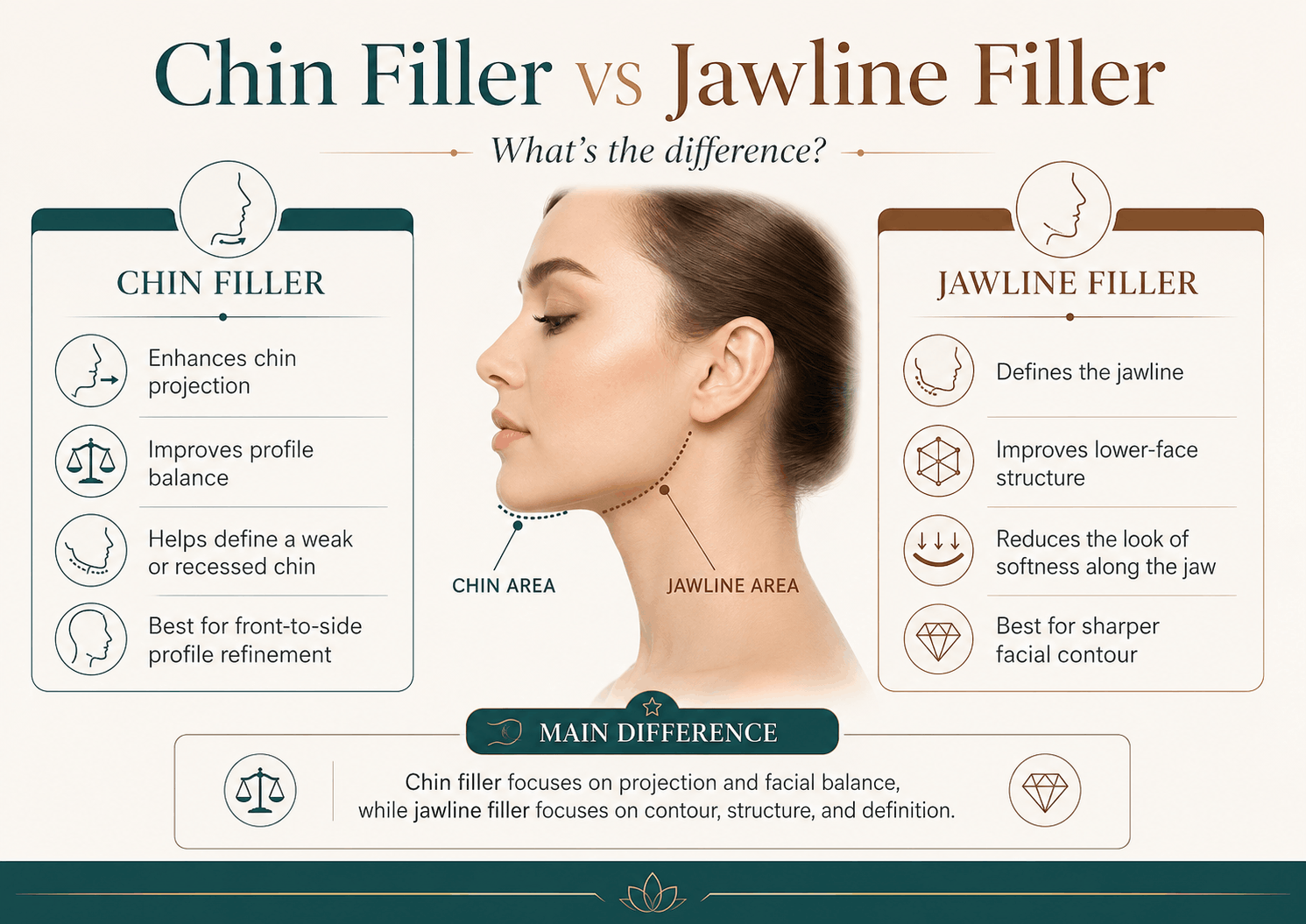
When comparing chin filler vs jawline filler, the easiest way to understand the difference is to look at what each treatment is primarily trying to change.
Chin filler is mainly about projection and proportion.
It can make the chin appear more forward, defined, or balanced in relation to other facial features. This is why it may have a more noticeable effect when your main concern is your side profile.
Jawline filler is mainly about contour and definition.
It can add structure along the jaw and create a clearer outline, particularly when viewed from the front or at an angle.
Chin Filler | Jawline Filler |
Focuses on chin projection | Focuses on jawline definition |
Can improve side-profile balance | Can enhance front and three-quarter views |
May alter chin length or shape | Can strengthen the mandibular contour |
Addresses proportion | Addresses structure and contour |
Often focuses on a specific central area | May involve several points along the jaw |
Neither treatment is automatically better. The appropriate option depends on the feature creating the perceived imbalance.
Is Chin Filler or Jawline Filler Better for Profile Balance?
If your main concern is a weak or recessed side profile, chin filler may have the greater visual effect.
The chin sits at the front of the lower jaw, so changing its projection can alter the relationship between the lower face, lips and nose. This can make a difference even when only a relatively subtle amount of filler is used.
Jawline filler can still contribute to a stronger profile, particularly around the angle of the jaw, but its primary purpose is usually contour rather than forward projection.
This means the answer to chin filler vs jawline filler depends on what you want to change.
If your concern is:
A recessed chin: chin filler may be considered.
A poorly defined jaw: jawline filler may be more appropriate.
An unbalanced lower face: your practitioner may recommend assessing both areas before deciding on treatment.
The aim should be proportion, not simply adding as much definition as possible.
Can Treating Both the Chin and Jawline Create Better Balance?
In some cases, yes. Chin and jawline contouring can be planned together when both areas contribute to an individual’s concerns.
For example, someone may have a slightly recessed chin combined with a soft mandibular outline. Treating only the jawline could add definition without addressing the central projection of the chin. Conversely, treating only the chin may improve the side profile while leaving the outer jawline less defined.
A combined approach does not necessarily mean using a large amount of filler. Conservative treatment at carefully selected points may be enough to create a more cohesive appearance.
The goal of dermal fillers for facial balance should be to improve the relationship between features rather than make individual areas look exaggerated.
Why Can Treating Only One Area Sometimes Look Unbalanced?
The lower face works as a connected structure. Changing one area can affect how another area is perceived.
For instance, adding significant volume to the jawline while leaving a recessed chin unchanged may make the lower face appear wider without improving forward projection.
Similarly, adding too much volume to the chin without considering the jawline may produce a chin that looks more prominent but does not blend naturally into the rest of the lower face.
This is why an experienced injector evaluates facial proportions, asymmetry, soft tissue, and the patient’s desired outcome before deciding where filler should be placed.
A consultation may include photographs, facial measurements, and an assessment of the areas you want to change.
How Long Do Chin and Jawline Filler Results Last?
There is no single duration that applies to every filler or every patient.
Longevity can depend on:
- The type of filler used
- The amount injected
- The treatment area
- Individual metabolism
- Facial movement
- Lifestyle factors
- The technique used
Some jawline filler treatments are reported to last approximately 12 to 18 months, although individual results can vary.
Dermal fillers are not permanent treatments. Maintenance may eventually be needed if you want to preserve the effect.
What Are the Risks of Chin and Jawline Filler?
Although dermal filler is a minimally invasive treatment, it is still a medical procedure with potential risks.
Short-term effects can include swelling, bruising, redness, tenderness, and discomfort. Less common complications include infection, nodules, and inflammatory reactions.
One of the most serious complications is accidental injection into a blood vessel. The FDA states that vascular complications can result in tissue damage, vision problems, or stroke, although these events are uncommon.
This makes injector training and anatomical knowledge particularly important. The FDA advises healthcare providers to understand the anatomy surrounding the injection site and to use appropriate products and techniques.
Before treatment, ask what product is being used, who will perform the injections, what risks apply to your treatment, and what aftercare is recommended.
How Do You Choose Between Chin and Jawline Filler?
The best choice depends on the reason you are unhappy with your lower face.
Chin filler may be considered if you:
- Feel your chin sits too far back
- Want greater chin projection
- Are concerned about side-profile balance
- Feel your chin looks short or underdefined
- Want to improve the relationship between your chin and other facial features
Jawline filler may be considered if you:
- Feel your jawline lacks definition
- Want greater lower-face structure
- Notice mild contour irregularities
- Want a more defined jaw-to-neck transition
Both may be considered if you:
- Have concerns with both projection and definition
- Want a more comprehensive lower-face assessment
- Are looking for subtle facial contouring rather than dramatic change
The important point is that treatment should follow assessment, not the other way around.
What Should You Expect During a Filler Consultation?
A good consultation should be more than choosing a filler and deciding where to inject it.
Your practitioner may discuss your aesthetic goals, examine your face from different angles, assess existing asymmetry, and review any previous cosmetic treatments. They may also explain the expected benefits, limitations, possible complications, and alternative options.
The FDA recommends discussing the specific filler being used and its potential risks with your healthcare provider.
You should also have an opportunity to ask questions and decide whether the proposed treatment fits your expectations.
So, Which Treatment Has the Bigger Impact?
When considering chin filler vs jawline filler, chin filler generally has a greater influence on a recessed or weak side profile because it directly changes chin projection.
Jawline filler is usually more focused on definition, structure, and contour. It can make the lower face appear more sculpted, particularly from the front and three-quarter angles.
However, there is no universal treatment that works best for every face. The right approach depends on your anatomy, the amount of projection or definition you already have, and what you want to change.
The most natural-looking results usually come from treating the lower face as a whole and using an appropriate amount of filler rather than chasing maximum definition.